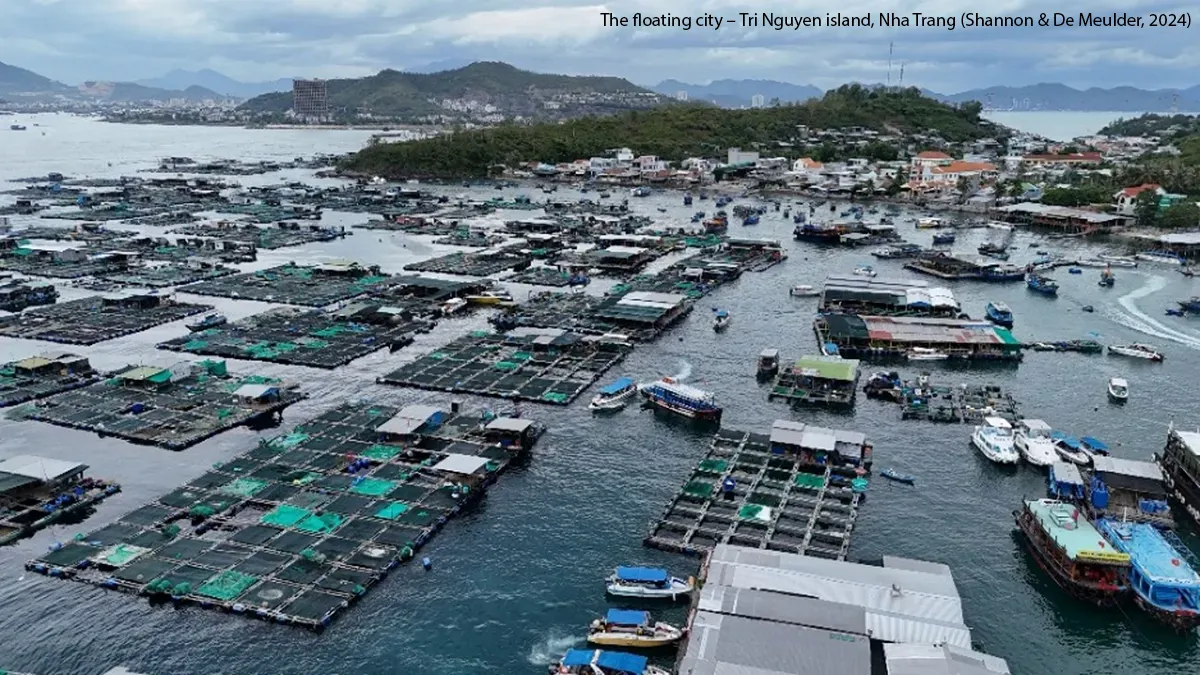
This paper studies the shifting livelihoods of Nha Trang’s traditional fishing communities through tourism-driven urban expansion. As a coastal city being acknowledged dates back from the Nguyen dynasty – 17th century – and thanks to its geographic character as a closed bay, Nha Trang was also an ideal location for the French and U.S. Army under the colonial time and the Vietnam war. These blessings of a beautiful and calm beach with pleasant weather turned Nha Trang into a desirable tourism destination for the locals in the early 2000s. Over time, globalization fueled the city’s growth as a national tourism attraction, drastically reshaping its socio-spatial dynamics. As urban development expanded, traditional fishermen’s villages – where they normally occupied the waterfront to be closer to the boats – were increasingly seen as “slums” and were sidelined in city planning efforts. In response, the government implemented relocation strategies, offering inland land and rowhouse settlements for fishermen. However, these efforts were largely unsuccessful; the fishermen frequently abandoned these new homes, preferring to go back and informally settle their new shacks near the waterfront, where they could access their boats and sustain their livelihoods.
This preference for waterfront living has led to the emergence of informal communities that adapt to urban pressures while preserving aspects of traditional life. Informal fishing productivity has evolved on floating platforms, initially used for fish and shrimp farming but now also transformed into floating restaurants – a new type of tourism service – with spaces demarcated and governed by the negotiations between locals. This self-regulated system illustrates how fishermen creatively negotiate their place within the city, forming unique socio-economic networks outside formal governance structures. Furthermore, in relation with the course, the study is closely related with informality in the city and people as infrastructure (Simone 2004) – where people inside the fishermen village act as infrastructure within their community. Through this study, I expect to gain the insights of how marginalized communities like the fishermen of Nha Trang navigate urbanization pressures, resist displacement, and create informal, yet functional, adaptations within the city’s expanding tourism economy.
Simone, AbdouMaliq. 2004. “People as Infrastructure: Intersecting Fragments in Johannesburg.” Public Culture.